
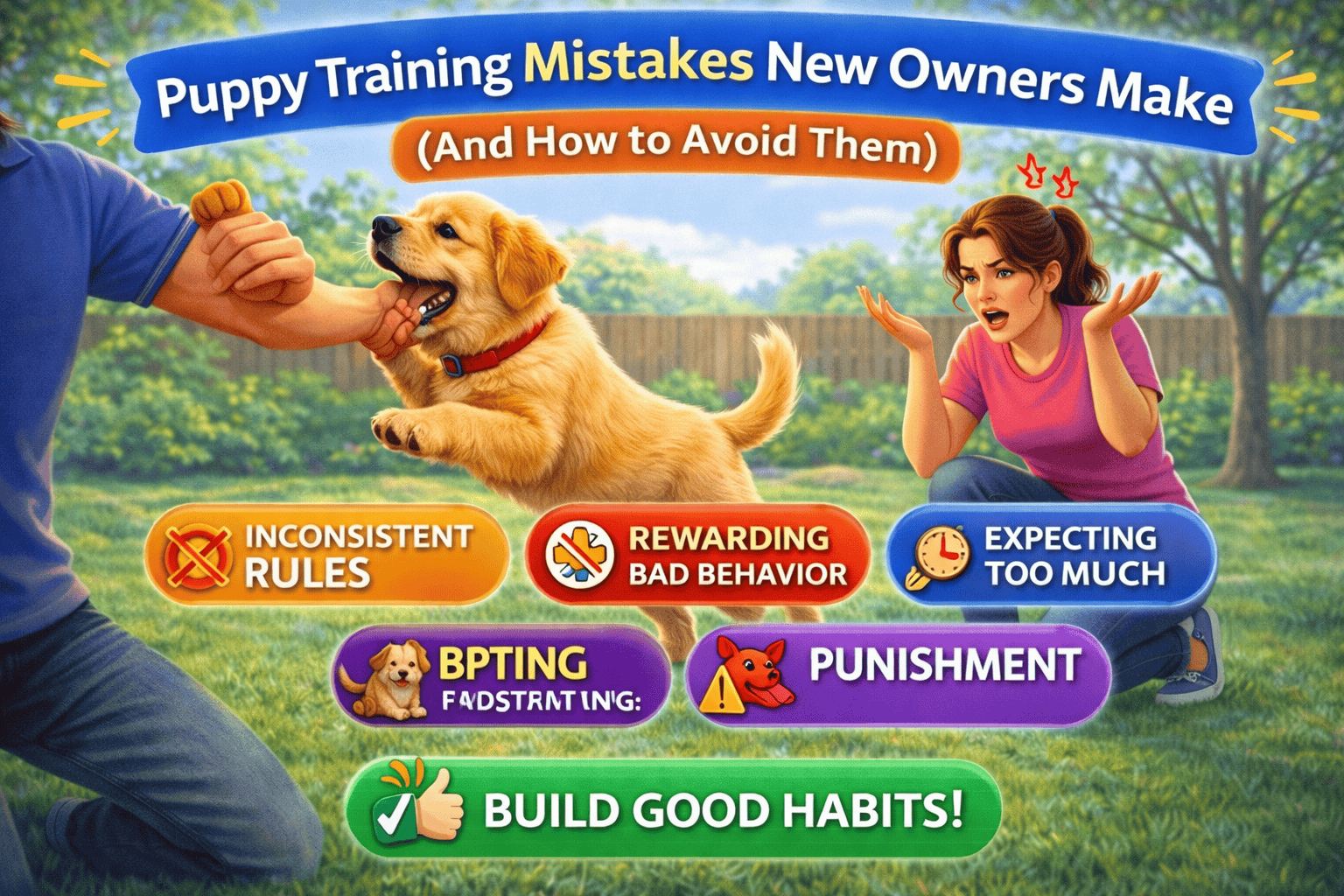
Raising a puppy can be exciting, but many new dog owners unknowingly make common puppy training mistakes that slow progress and create long-term behavior problems.
The good news is that most mistakes are easy to fix once you recognize them.
In this guide, you’ll learn:
- The most common puppy training mistakes
- How these mistakes affect behavior
- Simple ways to correct them
- How to train your puppy more effectively
Avoiding these mistakes can help your puppy learn faster and develop better habits.
Table of Contents
Puppy Training Mistakes (Quick Answer)
Common puppy training mistakes include inconsistency, lack of routine, rewarding bad behavior, and expecting too much too soon. Puppies learn best through repetition, structure, and positive reinforcement.
To avoid training mistakes:
- Stay consistent with the rules
- Reward good behavior immediately
- Keep training sessions short
- Establish daily routines
- Avoid punishment-based methods
Most puppies improve quickly when training becomes consistent.
Why Puppy Training Mistakes Matter
Understanding puppy training mistakes is important because early habits shape long-term behavior.
Mistakes during early training can lead to:
- jumping on people
- leash pulling
- biting and nipping
- poor recall
Fixing mistakes early helps prevent bigger problems later.
7 Common Puppy Training Mistakes
1. Inconsistent Rules
One of the biggest puppy training mistakes is inconsistency.
If one person allows behavior and another corrects it, puppies become confused.
2. Rewarding Bad Behavior
Giving attention when your puppy jumps, barks, or bites can reinforce those behaviors.
Even negative attention can act as a reward.
3. Training Too Long
Puppies have short attention spans.
Training sessions should last 5–10 minutes for the best results.
4. Expecting Too Much Too Soon
Puppies are still learning.
Expecting perfect behavior too early leads to frustration.
5. Lack of Routine
Without structure, puppies struggle to learn.
A consistent schedule helps with:
- potty training
- sleep
- behavior
Our puppy potty training schedule explains how to build effective routines.
6. Not Socializing Enough
Skipping early exposure can lead to fear and anxiety later.
Following a puppy socialization checklist helps build confidence.
7. Using Punishment Instead of Training
Punishment can create fear and confusion.
Positive reinforcement is far more effective for teaching behavior.
How to Fix Puppy Training Mistakes
If you’ve made some of these puppy training mistakes, don’t worry — they can be corrected.
Be Consistent
Use the same commands, rules, and expectations every day.
Reward the Right Behavior
Focus on reinforcing what your puppy does correctly.
Keep Training Simple
Break training into small steps.
Build Daily Routines
Structure helps puppies understand expectations.
During the first 30 days with a new puppy, establishing routines is especially important.
Training Works Better When Skills Are Connected
Many behaviors improve when training is connected.
For example:
- Puppies that learn recall improve focus
- Puppies that stop biting become calmer
- Puppies with structure sleep better
Our guide on how to train a puppy not to bite explains how to manage early behavior.
If your puppy struggles with focus, teaching recall can help improve it. Our guide on training a puppy to come when called explains how to build this skill.
Recommended Training Programs
Some dog owners prefer structured training guidance.
Online dog training programs can help with:
- obedience training
- behavior correction
- routine building
- improving focus
One option many owners explore is SpiritDog Training, which offers step-by-step programs for everyday training challenges.
👉 Explore the training programs here.
🧠 People Also Ask
Here are answers to common questions about puppy training mistakes:
What is the biggest mistake when training a puppy?
The biggest mistake is inconsistency. Puppies learn best when rules and expectations remain the same.
What is the biggest mistake when training a puppy?
The biggest mistake is inconsistency. Puppies learn best when rules and expectations remain the same.
How do I correct bad puppy behavior?
Focus on rewarding good behavior, redirecting unwanted actions, and maintaining consistent training routines.
How do I correct bad puppy behavior?
Focus on rewarding good behavior, redirecting unwanted actions, and maintaining consistent training routines.
How long does it take to properly train a puppy?
Most puppies begin showing progress within 2–4 weeks, but full training takes several months.
How long does it take to properly train a puppy?
Most puppies begin showing progress within 2–4 weeks, but full training takes several months.
Can you fix puppy training mistakes later?
Yes. Dogs can learn at any age, but early training produces faster results.
Can you fix puppy training mistakes later?
Yes. Dogs can learn at any age, but early training produces faster results.
Why is my puppy not learning?
Lack of consistency, unclear communication, or distractions can slow learning.
Why is my puppy not learning?
Lack of consistency, unclear communication, or distractions can slow learning.
Frequently Asked Questions
Why does my puppy keep repeating bad behavior?
Puppies repeat behaviors that get attention or rewards, even unintentionally.
Why does my puppy keep repeating bad behavior?
Puppies repeat behaviors that get attention or rewards, even unintentionally.
Should I punish my puppy for mistakes?
No. Positive reinforcement works better and avoids fear-based behavior.
Should I punish my puppy for mistakes?
No. Positive reinforcement works better and avoids fear-based behavior.
What is the best way to train a puppy?
Consistency, short sessions, and rewarding good behavior are the most effective methods.
What is the best way to train a puppy?
Consistency, short sessions, and rewarding good behavior are the most effective methods.
When should I start training my puppy?
Training can begin as early as 8 weeks old.
When should I start training my puppy?
Consistency, short sessions, and rewarding good behavior are the most effective methods.
Final Thoughts
Avoiding common puppy training mistakes can make a huge difference in how quickly your puppy learns.
By staying consistent, rewarding positive behavior, and building routines, you can help your puppy develop into a well-behaved dog.
Training doesn’t need to be complicated — small, consistent efforts produce the best results.
Hi! Do you use Twitter? I’d like to follow you if that would be okay. I’m undoubtedly enjoying your blog and look forward to new posts.
@aftgalleygreg on Twitter